

What is human trafficking?
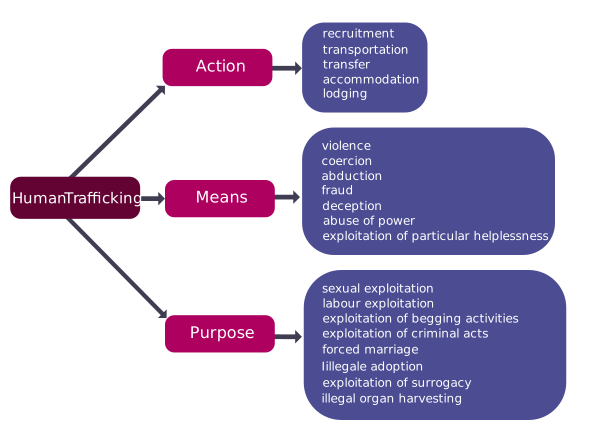
Human trafficking is the practice of exploiting people by placing them in a vulnerable situation. This often involves coercion, duress, deception, or violence. Human trafficking is a human rights violation and can occur within a country or across national borders, in all sectors, and affect a wide variety of people.
Definition
Human trafficking is a serious human rights violation. Human trafficking involves placing individuals in exploitative situations by taking advantage of their vulnerable state, economic hardship, or vulnerability abroad. The latter refers to situations where people find themselves in a country whose language they do not speak or barely speak, whose legal system they are unfamiliar with, and where they lack a social support network. Human trafficking often involves coercion, duress, violence, or deception. The individuals' freedom of action is so severely restricted for the purpose of exploitation that they can no longer freely dispose of their labor or determine their own circumstances.
There are different forms of exploitation:
When a person's predicament or helplessness is exploited to force them into prostitution or other sexual services through which they are exploited, this is referred to as human trafficking for sexual exploitation and forced prostitution.
Human trafficking for the purpose of sexual exploitation can be divided into three steps:
- Recruitment (human trafficking)
- Arrangement to engage in exploitative activity (forced prostitution)
- Exploitation
According to Section 232 (1) a of the German Criminal Code, human trafficking for sexual exploitation occurs when a person's personal or economic distress or helplessness due to their stay in a foreign country is exploited and this person is recruited, transported or accommodated for the purpose of sexual exploitation.
Inducing exploitative activity is covered by Section 232a of the German Criminal Code as forced prostitution. This includes persuading the person concerned to engage in or continue prostitution or sexual activity by exploiting their distress, their helplessness associated with their stay in a foreign country, or their young age (under 21). The person who forces someone into prostitution does not have to be the same person who recruited or transported them.
- Section 233a of the German Criminal Code covers cases in which sexual exploitation or other forms of human trafficking take place through deprivation of liberty, i.e. locking someone in.
Human trafficking for sexual exploitation can affect migrants as well as people born and raised in Germany. Nationality is not relevant, as well as crossing of borders does not necessarily have to occur.
Recruitment often takes place under false pretences, with victims being deceived, e.g. by advertisements about the nature of the work or the working conditions. As a result, victims may find themselves confronted with working conditions to which they did not previously agree to and be forced to offer sexual services under these conditions. Other means of coercion can include, for example, withholding of identity documents, physical or psychological violence, deprivation of food, coercion, blackmail, constant surveillance, threats against family members, or the partial or complete surrender of earnings.
We are aware that the issues of human trafficking and sexual exploitation in particular are the subject of intense social and political debate. We attach great importance to the distinction between sexual exploitation and sex work or prostitution. For information on sex work and prostitution, please contact the relevant experts, e.g. specialised counselling centres or professional associations.
Human trafficking for labour exploitation involves someone taking advantage of workers' distress, helplessness or lack of language skills, or forcing them to perform work that exploits them. The victims' ability to act is restricted to such an extent that they are no longer free to dispose of their labour. They are not paid or are paid inadequately and have to work in poor or even dangerous conditions.
This form of human trafficking is regulated under Section 232 of the German Criminal Code (human trafficking), Section 232b of the German Criminal Code (forced labour) Section 233 StGB (Exploitation of Labour) and Section 233a StGB (Exploitation of Labour through Deprivation of Liberty). The boundaries between the different forms are often blurred.
In simple terms, human trafficking for the purpose of labour exploitation can be divided into three types of activity:
- Recruitment (human trafficking)
- Arrangement of exploitative activity (forced labour)
- Exploitation (exploitation of labour through underpayment, dangerous working conditions, withholding of wages)
Recruitment, transport and exploitation of victims are similar to those involved in human trafficking for sexual exploitation, and both forms of exploitation can also occur in parallel or consecutively. Human traffickers exploit the material hardship and psychological or social vulnerability of their victims. Victims are persuaded to take the risk of working abroad with false promises of lucrative work. Human traffickers may present themselves as successful entrepreneurs or powerful intermediaries. They often present employment contracts with fictitious companies. The contracts frequently contain false information, e.g. that the victims have health insurance or that the working hours are much shorter than they actually are.
Debt bondage is not an uncommon practice. In such cases, the victims are not asked to pay for placement, transport, food and/or accommodation in advance, but only after they have received their first salary. By the time they are due to receive their wages, their alleged debts have been inflated to such an extent that they cannot be repaid. Often, those affected are also cheated out of their pay or put off, or they only receive partial payments. High rents are charged for accommodation in miserable, often unhealthy premises, as well as for provisions of food provided by the employers. Over the course of months, the debts grow rapidly, are unclear and uncontrollable for those affected, and often reach exorbitantly high amounts.
Labour exploitation can affect all genders. While men are mostly employed in agriculture, factories, slaughterhouses, the transport industry or on construction sites, women are often employed in agriculture, tourism (hotels and guesthouses), by cleaning companies, in domestic care for the elderly with 24-hour care, in the catering industry (restaurants and fast food) and in family households (often in Diplomats households).
Working conditions are harsh – excessive working hours, often physically demanding work, lack of health protection, insufficient rest periods and breaks, little and often controlled free time, significantly lower wages than market rates or no compensation at all are typical characteristics of exploitation. In many cases, there is no German health insurance or work-related accident insurance, and employers do not pay social security contributions.
In addition to physical exhaustion, the apparent hopelessness, feelings of helplessness and disappointment of not being able to support the family back home take their toll. Those affected experience the situation as traumatic. It is almost impossible for those affected to break out of the chain of exploitation. On the one hand, low levels of education and a lack of language skills lead to communication barriers. On the other hand, the threats posed by human traffickers and their networks, in conjunction with other manipulative means, can create complex relationships of dependency.
Begging itself is not a criminal offence in Germany, as long as no specific municipal bans have been imposed and there is no exploitation by others.
‘Exploitation of begging activities’ has only been a separate criminal offence since the revision of the criminal law provisions on human trafficking in 2016.
Exploitation occurs when people are forced to beg and hand over their earnings, and when perpetrators take advantage of their economic or personal predicament, helplessness and ignorance of the circumstances in Germany. Victims of forced begging are often exposed to health-threatening conditions at work, violence and deprivation of food by the perpetrators. In many cases, the accommodation of those affected is inadequate, as they often have to sleep and live in dilapidated buildings, tents and public spaces; victims also often find shelter in homeless shelters.
It is often organised criminal structures that deliberately deploy and exploit beggars.
It is important to note that in cases of exploitation of begging activities, there are often family ties between the exploiters and the exploited. This often results in very close contact, as the perpetrators are members of the same community or family and use this to exert pressure.
Those affected are predominantly very poor people, often elderly people or people with physical and/or mental disabilities, who, in addition to the use of children, are deliberately exploited to elicit pity from passers-by. Children are therefore often exploited together with their parents in this form of exploitation.
In addition, those affected are monitored and controlled while begging, which means that they have to endure many hours even in adverse weather conditions.
It is difficult for outsiders to tell whether a person is begging to earn a living or is being exploited. An indication of human trafficking for begging is also present when people are taken to the place where they beg and picked up again afterwards.
Given their dependence on the traffickers and their inability to act, it is very difficult for those affected to break free. When third parties intervene, those affected often show a lack of cooperation out of fear of the perpetrators. Providing help and support is also often challenging due to the possible physical and/or psychological conditions of those affected.
The expression ‘exploitation of criminal activities’ should be understood as the exploitation of a person to commit, inter alia, pick-pocketing, shop-lifting, drug trafficking and other similar activities which are subject to penalties and imply financial gain. [1]
German criminal law criminalises both the recruitment, transport, accommodation, etc. for the purpose of exploiting criminal activities (StGB §232, (1)d) and the exploitation of these activities (StGB §233, (1) 3 (exploitation of labour) as punishable offences.
With the aim of exploiting criminal activities, perpetrators specifically seek out individuals who can be coerced into committing crimes such as theft, drug trafficking or credit card fraud. The perpetrators' aim is to gain financial profit from the crime without committing the act themselves. The advantage for the traffickers is that the victims are making themselves liable to prosecution and can therefore be blackmailed. The perpetrators threaten the victims with police and prison.
Perpetrators often start by forcing victims to commit minor offences. Once victims have been ‘trained’ to commit crimes without getting caught, perpetrators force them to commit more serious crimes.
In order to prevent victims of human trafficking from being punished for crimes committed under duress, the EU Directive signed by Germany provides for ‘waiver of prosecution or immunity from punishment for victims’ in accordance with Article 8.
Source:
[1] (Directive 2011/36/EU of the European Parliament and of the Council of 5 April 2011 on preventing and combating trafficking in human beings and protecting its victims, and replacing Council Framework Decision 2002/629/JHA PDF)
A forced marriage occurs when a marriage is entered into against the will of one or both parties. One or both spouses are coerced into marriage through psychological pressure or even severe physical violence.
In many cases, the victims are minors, in which case the marriage is classified as a child marriage under the UN Convention on the Rights of the Child. Child marriages are also a form of forced marriage, as minors are not yet able to defend themselves adequately, let alone assess the consequences of marriage.
Forced marriage has also been prohibited under criminal law in Germany since 19 February 2005 as a serious form of coercion.
Forced marriage violates the right to freedom of marriage, as enshrined in the United Nations Universal Declaration of Human Rights 48 (Article 16, paragraph 2), among other places. This right is also enshrined in the Basic Rights of the Federal Republic of Germany (Art. 6, para. 1). Forced marriage has far-reaching consequences for the life and development opportunities as well as the mental health of those affected.
Arranged marriages are a tradition in many countries around the world. Parents look for suitable spouses for their children and sometimes engage marriage brokers. If the daughter or son agrees with the match and the choice of partner and wants to get married, this union is not a forced marriage, but an arranged marriage. In practice, the distinction is often difficult to make and the boundaries are fluid.
‘Illegal adoption’ refers to the unlawful placement or transfer of a child for permanent placement in a family in return for payment, without complying with the applicable legal procedures. In such cases, the focus is not on the welfare of the child, but solely on the financial or personal interests of third parties.
EU Directive 2024/1712 officially recognises illegal adoption as a form of exploitation within the meaning of human trafficking. This obliges EU Member States to prosecute such cases. In Germany, this is punishable under Section 236 of the Criminal Code as ‘child trafficking’. The offence is particularly serious if it is committed commercially or if the child is physically or emotionally harmed.
In most cases, official adoption procedures are circumvented by placing children in private procedures in return for payment, providing false information about their origin. Adoptive families sometimes unwittingly engage in illegal adoption procedures.
Human traffickers often exploit the vulnerable situation of families of origin to pressure them into giving up or selling their children. Triggered by economic and social hardship, some children are deliberately brought into the world so that they can be put up for adoption.
Indications of illegal adoption include circumventing official, legally regulated adoption procedures, falsifying family circumstances and ‘bringing’ children from another country.
In surrogacy, a child is carried for other people who want to become parents. In many countries, this process is legally permitted and regulated (e.g. USA, Portugal, Greece).
‘Exploitation of surrogacy’, on the other hand, occurs when a person is coerced, deceived or exploited due to their vulnerable life situation into carrying a pregnancy for a third party. Vulnerable life situations are often exploited and money or other things are promised – but these promises or agreements are not kept. In most cases, the individuals involved do not know what will happen to them or the child, as they are deliberately misinformed and deceived.
EU Directive 2024/1712 recognises exploitative surrogacy as a form of exploitation in the context of human trafficking, which obliges EU member states to prosecute it. The directive must be transposed into national law in Germany by 2026 at the latest. Surrogacy is currently prohibited in Germany. The Embryo Protection Act and the Adoption Placement Act stipulate that professionals and intermediaries involved in the organisation and implementation of surrogacy are liable to prosecution. The prospective parents and the surrogate mother can be prosecuted if the welfare of the child is endangered.
Human trafficking can occur in all sectors and affect all people. Human trafficking is a form of organized crime.
Criminal law regulations
The German Criminal Code defines what human trafficking means in a legal sense: According to Section 232 of the German Criminal Code (StGB), the recruitment, transportation, receiving and harbouring of a person by exploiting a situation of duress or helplessness with the aim of exploitation constitutes human trafficking and is therefore a criminal offense.
The term "human trafficking" in the German Criminal Code (StGB) is thus relatively narrowly defined and refers only to the creation of conditions that enable exploitation, not the exploitation itself. The individual forms of actual exploitation are criminalized in the following sections of the StGB as forced labour, forced prostitution, exploitation of labour power, and exploitation by taking advantage of deprivation of liberty, as well as in section 180a of the StGB – exploitation of prostitutes.
Currently, the criminal offense of human trafficking (§ 232 of the German Criminal Code) lists five forms of exploitation. With the reform of the EU Trafficking in Human Beings Directive in 2024, the exploitation of surrogacy, forced marriage, and illegal adoption were added as new forms of exploitation. These must be transposed into German law by 2026.
The essential elements of the offense are the intent to exploit and the taking advantage of a situation of duress or helplessness that restricts the affected person's freedom of choice. Additionally, affected persons may be subjected to psychological or physical violence or deception. This can manifest itself in various ways:
- threats or blackmail
- unlawful withholding of documents or earned money
- bodily injuries
- isolation
- list
Young people are given special protection under legislation; therefore, in the case of persons under 21 years of age, there does not need to be a situation of duress or helplessness for the offense of human trafficking to be fulfilled.
Not all situations involving deception and violence constitute human trafficking. In particular, human trafficking should be distinguished from smuggling and prostitution. The KOK (Commission for Crime Prevention) has developed a list of indicators that can help identify human trafficking.
Where does human trafficking take place?
Although human trafficking is often associated with international crime or migration, it does not necessarily involve crossing a border. Human trafficking can also occur within a country.
Human trafficking and exploitation can occur in various contexts. The following sectors are considered particularly vulnerable to human trafficking because they typically do not require a high level of qualification and are labour-intensive:
- sex work/prostitution
- household / care / au pair
- gastronomy and hotel industry
- construction industry
- meat processing industry
- freight forwarding
- nail salons and beauty salons
- agriculture and seasonal work
However, human trafficking can occur in any industry.
Who is affected by human trafficking?
There is no single typical case of human trafficking. The backgrounds and stories of those affected are diverse. Anyone, regardless of age, nationality, or gender, can fall into a situation of exploitation. Minors can be just as vulnerable as adults, and migrants of different nationalities can be just as affected as people with German citizenship.
Certain groups of people are more vulnerable, meaning they are more susceptible to exploitation. This includes, in particular, people with precarious immigration status. Women and transgender people (TIN*) are also often especially vulnerable. In many countries, they have poorer access to education, are affected by structural disadvantages, and simultaneously bear a great deal of responsibility for family members.
More details about the background and causes of human trafficking, as well as statistics on human trafficking, can be found on the KOK website.
Situation of those affected
The situation of those affected is very difficult, and the circumstances they find themselves in further complicate their ability to seek help. They are pressured by perpetrators in a variety of ways, experience violence, or are threatened. They may only be able to move within the immediate vicinity of their workplace or may not be allowed to leave it; they are unfamiliar with the structures in Germany, do not know where to find help, and may not speak the language.
Many victims are severely weakened, physically exhausted, ill, and/or suffering significant psychological distress as a result of the coercive and exploitative relationship. Some are addicted to substances. Because usually at least a large portion of their earnings is withheld, victims often lack the financial means to, for example, find alternative accommodation.
Some victims may not even be aware that they have been the victim of a crime. They may also see themselves as partly responsible, for example, if they have violated immigration laws or worked without a work permit.
For those who have been forced to commit crimes, the fear of being prosecuted themselves is likely to be an even greater obstacle to seeking support.
Should you or someone else require assistance, you can contact a specialist advice centre near you. The KOK's *specialist advice centre search* provides support services and contact details for specialized advice centres for victims of human trafficking throughout Germany, as well as other counselling services.